

There are plenty of situations in single parent life when an extra pair of hands would make all the difference. A meeting runs past school pick-up, the car won’t start, or you need to get something done that really doesn’t lend itself to having a small child alongside you. Sometimes you just want an hour to yourself without having to organise it three weeks in advance. If you have family nearby who are willing and able to help, there might be someone you can call. But what happens when you don’t?
We asked the Frolo community who they turn to, and the answers reflected very different experiences of parenting alone. Some members have built strong networks through friends, school and other single parents. Others rely on paid childcare, arrange everything around the times their children are with their other parent, or do almost everything themselves. Alongside the practical suggestions, there was a clear sense of how difficult it can be to ask, especially if you’ve asked before and been disappointed.
Sometimes the answer is “myself”
Several of the shortest replies were also the most telling. “Myself,” said one member. “I don’t,” said another. One parent described carrying on through illness because the everyday responsibilities still needed doing, while another explained that a close friendship had drifted and their neighbourhood wasn’t somewhere people looked out for each other. These responses matter because advice about finding your village can feel rather hollow when you’re already exhausted and there isn’t an obvious person to approach.
Having very little support doesn’t mean you’re doing single parenthood badly. You might have moved somewhere new, have family overseas, or live close to relatives who can’t offer practical help. Friends can care deeply and still have limited time, money or flexibility. It’s possible to understand all of that and still feel sad, frustrated or worn down by how much falls to you. Before talking about ways to build support, it’s worth acknowledging that some parents are managing an enormous amount without the backup they need.
Friends and school parents can become people you rely on
For members who did have people to ask, friends and other parents at school came up repeatedly. One parent described how their son’s best friend’s family helped out, alongside a wider school community they felt comfortable approaching. Another mentioned friends who noticed when they were under stress and offered support. These are different kinds of help: sometimes you need someone who can collect your child, and sometimes you need someone to recognise that you’re struggling before you’ve found the words to say so.
If there are parents you already chat to, a small, specific arrangement can be a starting point. Perhaps you could alternate taking the children to an activity they both attend, or occasionally cover a short gap after school. Familiarity gives you time to get to know each other and see what feels comfortable for you and your children. Support doesn’t have to begin with asking someone to become your emergency contact; it can develop through ordinary, repeated moments of helping each other out.
Asking can feel harder than doing it yourself
One member summed up a feeling others may recognise: they ask friends if they can’t work something out themselves, but feel like a burden doing so. When you’re used to being the person who keeps everything running, needing help can come with a surprising amount of discomfort. You might worry about interrupting someone’s day, being turned down, or creating an obligation you won’t be able to repay. Sometimes the task itself feels easier than navigating all those feelings.
A specific request can make the conversation more manageable for both people. Asking whether someone could collect your child on Thursday and keep them until half past four gives them something clear to consider. If you’re offering help to a single parent, the same principle works in reverse: “I’m going to the supermarket; what can I pick up?” is easier to respond to than “Let me know if you need anything.” And although mutual support can be lovely, you don’t have to immediately repay every favour. There will be times when you have more to give and times when you need more help.
Different needs may have different answers
One Frolo member, whose family are all in Hong Kong, described having supportive friends locally and access to affordable childcare through their childminder’s daughter. Another called holiday clubs their rescuer. Elsewhere in the conversation, a parent explained that they organise things for when their children are with their dad, while still finding it difficult to identify a babysitter everyone feels happy with. There wasn’t one arrangement that solved everything, and even parents with some support had gaps.
Where it’s affordable and available, paid childcare can provide breathing space as well as cover for work. A trusted co-parent may also be part of the picture where the relationship allows it, although that won’t be an option for everyone. It can help to think about the particular gap you’re trying to fill: occasional childcare, help with a practical job, company at the weekend, or somebody to talk things through with. You may find different people for each, rather than one person who can step into every situation.
Other single parents can become part of your support network
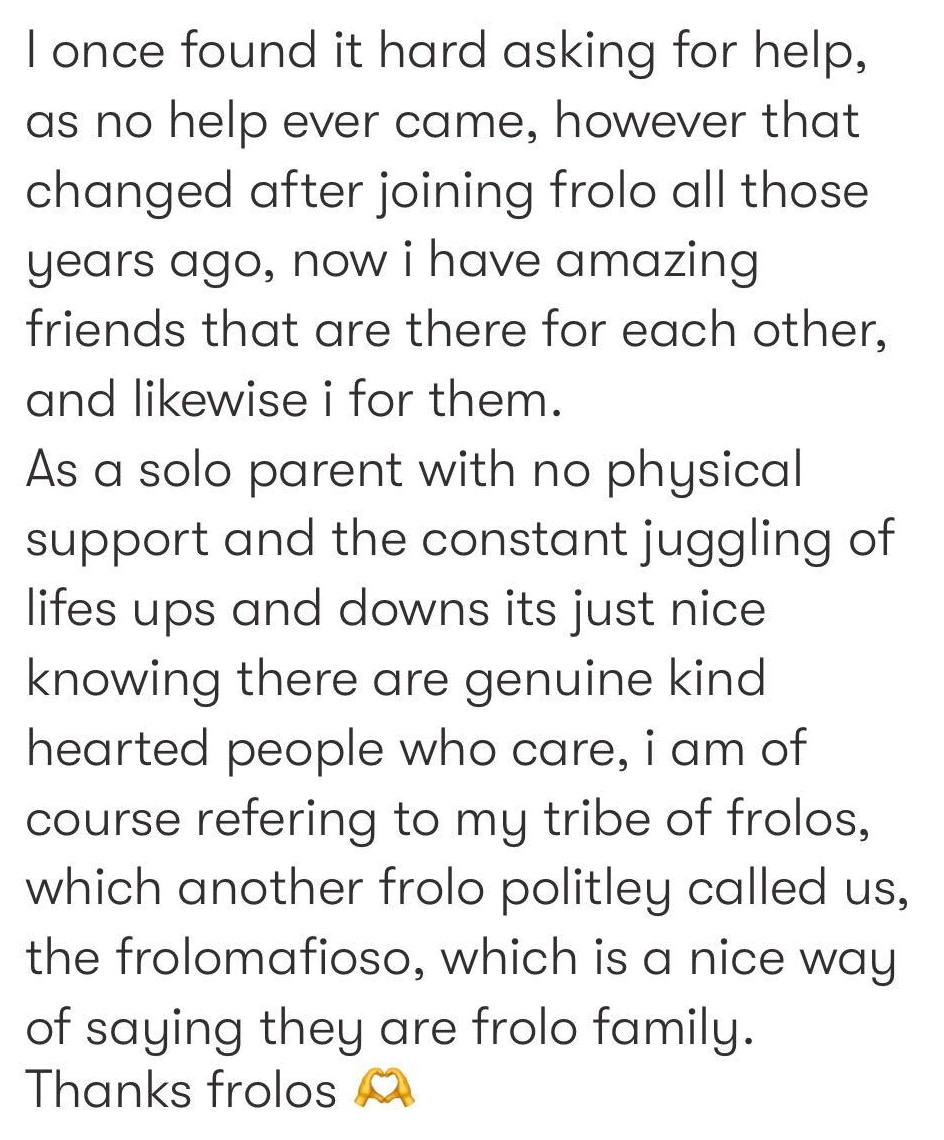
Graham’s response offered a hopeful example of how things can change. He explained that he once found asking for help difficult because no help came, but that friendships made through Frolo had given him people who were there for each other. As he put it, “it’s just nice knowing there are genuine kind hearted people who care”. He described those friends as his Frolo family, with support going in both directions.
Those relationships take time, and joining a community won’t instantly produce someone who can cover tomorrow’s school run. But it can give you somewhere to begin: a conversation with someone nearby, a meetup where the children can play, or a familiar face you see again. You don’t have to arrive ready to ask for a favour. Getting to know people who understand the logistics of single parent life can be valuable in itself, with practical support sometimes growing from that friendship.
If you’re parenting without family nearby, you’re welcome in the Frolo community whether you’ve built a strong local network or are still doing almost everything alone. You can share what’s helped, talk about what’s missing, or start by getting to know other single parents. There’s room for the difficult answers to this question as well as the hopeful ones.
Sign up to our newsletter
The latest advice from the Frolo blog, community highlights and upcoming meetups. Every week, free.
Unsubscribe any time. Privacy Policy
Follow us


